Digestive symptoms people notice before seeking care
It often starts with something small you can’t quite pin down: a waistband that feels tight by mid‑afternoon, a sour taste that shows up only when you bend to tie your shoes, or a “busy” abdomen that gets loud in quiet rooms. Some people notice they’re suddenly planning errands around bathroom access, while others go the opposite direction—days of sluggishness, then a morning that feels urgent and unpredictable. Because the discomfort comes and goes, it’s easy to blame one meal, a stressful week, or a new supplement, even when the pattern keeps resurfacing.
What usually nudges people toward seeking care isn’t just the symptom—it’s the way it starts to behave. Heartburn that used to follow spicy food now appears after a normal dinner. Bloating lasts into the next day. Gas becomes more painful than embarrassing. Constipation or diarrhea cycles back often enough that “normal for me” starts to feel like a moving target. And when changes come with red flags—blood, persistent vomiting, fever, unintentional weight loss, trouble swallowing, or steadily worsening pain—they tend to stand out as a different category of problem.
Why the same symptom can have different causes
You might eat the same lunch you always do and still feel a different kind of full—more pressure than hunger, more stretch than satisfaction. That’s part of what makes digestive symptoms so slippery: the sensation is real, but the “why” isn’t always consistent. Bloating can come from extra gas, slower movement of food, constipation that’s building quietly, or even swallowing more air when you’re rushed. Heartburn can flare from reflux, but also from a stomach that’s emptying more slowly, a late meal plus lying down, or certain medications that relax the valve at the top of the stomach.
Even diarrhea can point in different directions depending on timing. A sudden, short-lived episode after travel or a questionable meal behaves differently than loose stools that keep returning after coffee, stress, or specific carbs. And the same person can have multiple drivers at once—sleep debt, anxiety, an iron supplement, and a “healthy” fiber increase—so the symptom looks like one thing on Monday and something else by Friday. That overlap is often where the confusion starts.
Underlying patterns that make symptoms recur over time
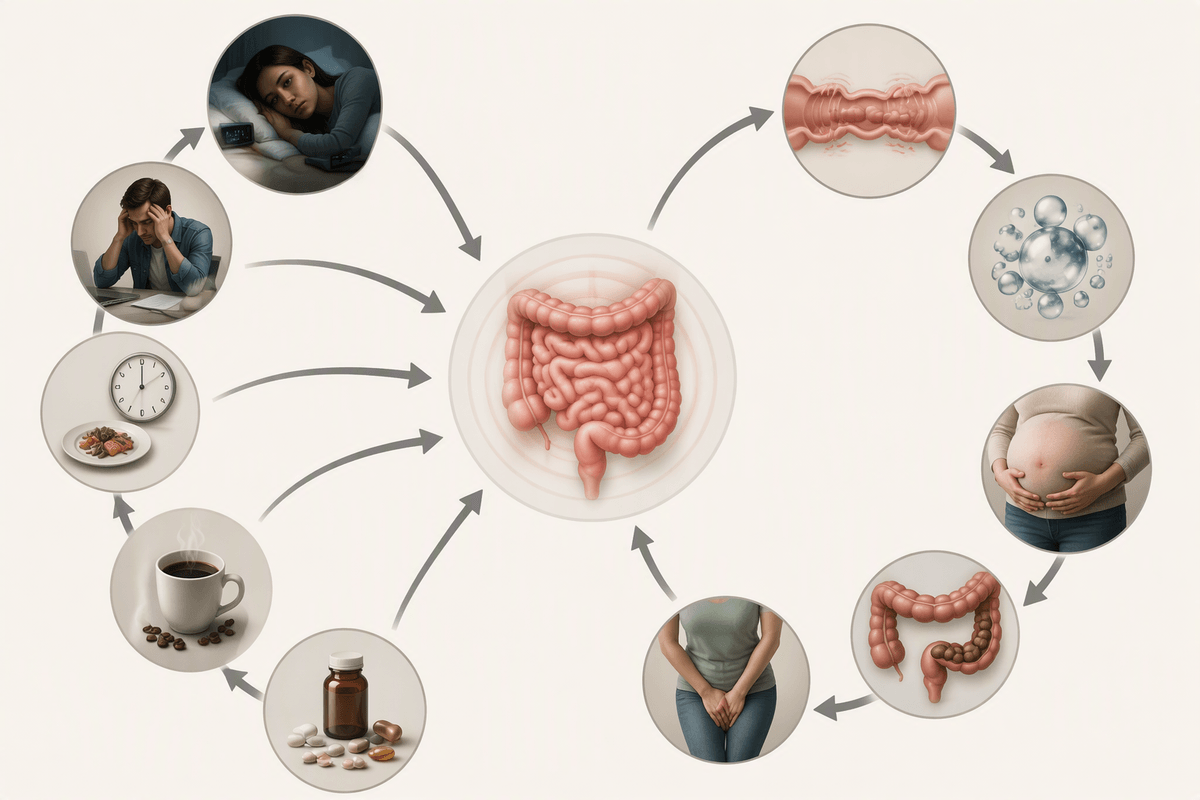
It can be a little maddening when you have a “good” week and then, without a clear mistake, the same heaviness or burning shows up again. Often the pattern isn’t one food so much as the conditions around it: smaller changes in sleep, stress, or meal timing that quietly shift how fast the gut moves. When motility slows, constipation can build in the background, and bloating starts earlier in the day. When motility speeds up, the same breakfast can feel fine one morning and too urgent the next—especially if caffeine, anxiety, or a new supplement is in the mix.
Another recurring loop is the fix that creates its own wobble. A big jump in fiber, sugar alcohols, protein powders, or “gut health” products can change gas production and stool consistency before things settle—if they settle. Acid reducers, antacids, pain relievers, iron, and some antibiotics can also nudge symptoms in inconsistent ways. What makes it worth paying attention is less the bad day and more the drift: episodes getting more frequent, lasting longer, or coming with appetite or weight changes that don’t match your usual swings.
Clues that narrow down what might be happening
Sometimes the clue is as basic as when the discomfort shows up. If you wake up already bloated, it can feel less like “something I ate” and more like yesterday’s slowdown carrying over—especially if stools have gotten smaller, harder, or less frequent without you fully noticing. If the pressure ramps up predictably after certain meals (or only after larger, faster meals), that points toward a trigger-and-response pattern, even if the trigger isn’t always the same ingredient.
The details that seem annoyingly inconsistent often help narrow the possibilities. Burning that’s worse when you lie down, bend, or exercise soon after eating behaves differently than chest or upper-belly discomfort that shows up on an empty stomach. Diarrhea that wakes you from sleep tends to “read” differently than loose stools that cluster after coffee, anxiety, or a rushed morning. And the “different level” signals—symptoms steadily escalating, new trouble swallowing, blood, persistent vomiting, fever, or unexplained weight or appetite changes—are usually clearer than the day-to-day noise.
How digestive problems are commonly evaluated and diagnosed

It’s often a little deflating when you finally describe everything and the first questions sound almost too simple: “When did it start?” “What changed?” “What does a typical week look like?” But that’s usually the point. Because bloating, heartburn, and bowel changes overlap so much, the early part of an evaluation is often about sorting timing and trends—what happens after meals, what happens overnight, what’s truly new, and what’s been quietly building.
From there, the next steps tend to be practical rather than dramatic. A clinician may look for patterns in medications and supplements, ask about weight and appetite shifts, and check for bleeding, anemia, or signs of inflammation with basic labs or stool tests. If reflux or swallowing problems are part of the story, an upper endoscopy or pH testing may be used to look for irritation or structural issues. If bowel habits are changing, imaging or colon evaluation may be discussed—often guided by age, family history, and whether symptoms are escalating instead of cycling.
Treatment options and what they realistically change
Sometimes the first “treatment” is just noticing what changes when you try to fix it. An antacid can quiet burning within minutes but still leave you with the same heavy, pressured fullness after meals. A daily acid reducer may make nights easier, yet the throat irritation or morning cough can linger if late eating, alcohol, or certain meds are still part of the pattern. And with bowel symptoms, the effect can feel backwards at first: a stool softener helps passage but not the bloating you’ve been carrying; an irritant laxative works quickly but leaves the next day feeling jumpy and unpredictable.
That’s because many options target one piece of the loop—acid, water content, spasm, or bacterial load—without changing the underlying rhythm that keeps symptoms returning. Fiber, probiotics, and “elimination” diets can be helpful in some people, but they also introduce noise: more gas during the adjustment phase, accidental under-eating, or a false sense that every flare proves a new intolerance. If a plan only works at the cost of increasing restriction, rebound symptoms, or constant vigilance, that trade-off is information too.
When reasonable self-care creates new confusion or discomfort
You change one thing with the best intentions, and the body answers with a new complaint. A “gentle” fiber powder makes your abdomen louder and tighter for a week. Cutting dairy helps, but now you’re snacking less and the reflux feels sharper on an emptier stomach. A probiotic seems calming at first, then you notice a new pattern of gassiness that’s hard to separate from stress or a rushed lunch.
This is where self-care can blur the signal. Quick fixes often shift symptoms rather than erase them: antacids may mute burning while pressure and belching stay; laxatives can trade constipation for urgency; strict elimination can reduce bloating but also create under-fueling, constipation, or anxiety about eating. If you find yourself constantly “testing” foods, needing larger and larger doses, or seeing the baseline drift anyway—especially with blood, persistent vomiting, fever, trouble swallowing, or unplanned weight loss—that’s usually less about willpower and more about the pattern changing underneath.