Red candles, real bills, and a sinking feeling
The screen keeps refreshing and the red bars don’t stop. It’s not just a chart anymore—your 401(k) balance is lower than it was last year, the headlines sound urgent, and your group chat is suddenly full of “are you selling?” texts. Meanwhile the normal stuff still shows up: the mortgage draft, the day care invoice, the car that needs tires. Even if the bills are covered, the timing feels bad, like the market picked the exact month you needed things to be boring.
The pressure comes from not knowing which kind of drop this is while the clock keeps moving. That’s when a “simple” sell-or-hold decision turns into something heavier.
Most people don’t panic because they’re careless. They panic because the drop collides with real life. A 15% slide is annoying; a 15% slide right before a tuition payment feels like a trap. The mind starts doing math it can’t finish: “If it keeps falling, I should get out,” mixed with “If I sell and it bounces, I’ll never forgive myself.”
In that moment, the portfolio isn’t one problem—it’s three at once: the market moving fast, your cash timing, and your tolerance for regret. If those get mashed together, the next click tends to be emotional and expensive. The next step is slowing down long enough to check fear against facts.
The first mistake: checking fear before facts
The pattern is predictable: you open the app, see the damage, then go looking for a feeling that tells you what to do. Not information—permission. So the first tab is headlines, the second is your account, and the third is whatever chart makes the drop look “different this time.” Ten minutes later, the fear is higher, not lower, and now you’re making a decision with the same brain you use when a smoke alarm goes off: shut it down first, sort it out later.
The practical cost shows up fast. A market order gets placed during the noisiest part of the day, or a 401(k) exchange is submitted with no control over the next day’s price. Then the second-guessing starts: “Should I have waited until after the Fed meeting?” “What if this is the bottom?” That loop isn’t analysis—it’s stress spending.
What breaks it is a short fact check that happens before any trading screen: how much cash do you actually need in the next 30–90 days, where is it coming from, and what can’t be postponed. Until those numbers are written down, every red candle looks like a threat to your whole life, and the urge to “do something” will keep winning.
Separate two problems: volatility and cash needs
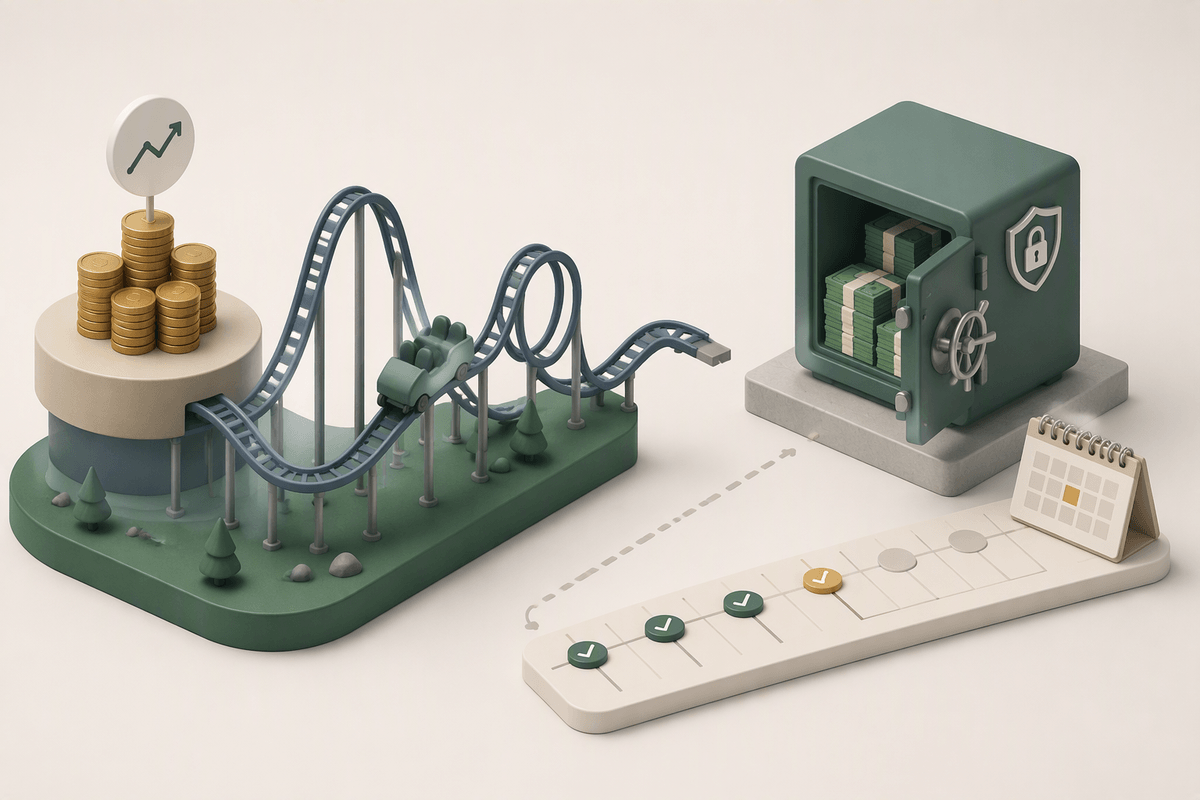
Once those numbers are on paper, something usually clicks: the market drop didn’t create every problem at once. It mostly made two problems feel like one. One is volatility—your account value is swinging around and your brain hates the uncertainty. The other is liquidity—whether you’ll need actual dollars on a specific date. They interact, but they don’t require the same action.
Start with the calendar, not the chart. Any cash you truly need in the next 30–90 days shouldn’t be waiting on a rebound to become “available.” If the plan was “I’ll sell some investments if I have to,” that’s already a timing risk, and the selloff just exposed it. Tuition due on October 1 doesn’t care what the S&P does next week. If the cash isn’t set aside, the portfolio is now funding a bill and absorbing volatility at the same time—a bad combo.
Then isolate what’s left. If your near-term cash is covered from paycheck, savings, or a money market position, the remaining stress is mostly price movement. That’s uncomfortable, but it’s not an emergency. Treating volatility like a cash crisis is how people sell long-term holdings to solve a short-term feeling. Treating a real cash need like “just volatility” is how they end up selling later, at worse prices, under a deadline.
If you must raise cash, sell with intention
Sometimes the numbers don’t give you an escape hatch. The bill is due inside the window, the cash isn’t there, and “wait it out” isn’t a plan—it’s hope with a deadline. When that’s true, the goal changes: you’re not trying to call the bottom. You’re trying to raise a specific dollar amount with the least lasting damage.
Start by setting the target in cash terms: how much, by what date, plus a buffer for taxes and transfer delays. Then sell from the place that keeps your long-term mix closest to intact. In a taxable account, that often means lots with smaller gains (or losses) to limit the tax hit; in a 401(k)/IRA, it’s usually about trimming what’s above your target weight rather than dumping what simply feels “risky.” The constraint is ugly but real: a rushed sale is still a sale, so make it a deliberate one.
If you need multiple chunks, take them in planned pieces instead of one emotional sweep. It lowers the odds that a single bad fill—or a single scary headline—decides the whole outcome.
If you can wait, choose your default action
When the next 30–90 days are covered, the decision changes again. Now the risk isn’t “can I pay the bill,” it’s “will I do something I can’t undo.” The market can keep falling, and nobody gets to know in advance whether this is a fast drop or a long grind. That uncertainty is exactly why you pick a default action ahead of time—so a bad week doesn’t turn into a permanent plan.
For most long-term accounts, the best default is boring: keep contributions and automatic buys running, don’t sell just to stop the pain, and only touch the portfolio if your allocation has drifted past a line you already agreed to. The constraint is psychological and practical: checking balances ten times a day makes “doing nothing” feel impossible. So reduce the checking, keep the schedule, and let time—not the next headline—be the deciding factor.
Rebalancing without regret: rules that fit reality

The next temptation is to “rebalance” as a way to feel smart again. But in a drawdown, rebalancing only helps if it’s tied to a rule, not a mood. The friction is timing: prices can keep sliding for weeks, and a single aggressive buy can feel like catching a falling knife. So keep it mechanical—only act when the drift is big enough to matter, and keep the size of the move small enough that it doesn’t hijack sleep.
Pick a trigger you can defend later: either a band (for example, 5 percentage points off target for a major stock/bond split) or a calendar (quarterly or twice a year). In a 401(k), that usually means exchanging from what held up into what fell, in one clean trade. In taxable, add the tax constraint: prioritize redirecting new contributions and dividends first, then sell winners only if the drift is truly outside the band.
Most regret comes from improvising. A simple rule—“rebalance once when the band breaks, then wait 30 days before doing it again”—keeps the portfolio from turning into a daily referendum on fear.
Your crash plan on one page
By the time the market is down hard, you won’t be “deciding,” you’ll be executing whatever you made easiest to do. So keep a one-page plan where you’ll actually see it: (1) Cash map: next 90 days of required bills, the exact accounts funding them, and a small buffer for taxes/transfer delays. (2) Default mode: “no selling for pain relief,” contributions stay on, checking limited to set days. (3) If cash is short: raise $X by date Y, sell in two tranches, and sell from what’s above target weight (tax-aware in taxable). (4) Rebalance rule: act only if drift breaches your band, then wait 30 days. When the next drop hits, the page does the thinking.