Why family history can feel clearer than genes
You’re halfway through a clinic intake form when the boxes start to feel oddly personal: “Mother—cancer?” “Age at diagnosis?” It’s tempting to answer from memory with a simple story—“it runs in my family” or “it was just bad luck”—because family history has faces, timelines, and phone calls attached to it. Genes, by contrast, can feel abstract: a report full of letters and categories that doesn’t match the lived reality of watching an aunt get sick, then a cousin, then someone else years later.
Family history often feels clearer because it shows a pattern you can recognize without a lab: the same cancer type repeating on one side, diagnoses happening younger than you expected, or certain pairings that keep showing up in relatives who share blood. Still, it isn’t perfectly tidy. Families are small, details get lost, and shared habits can mimic inheritance. So the “signal” you feel may be real—or it may be a convincing story built from incomplete memories.
Which family patterns tend to raise real suspicion
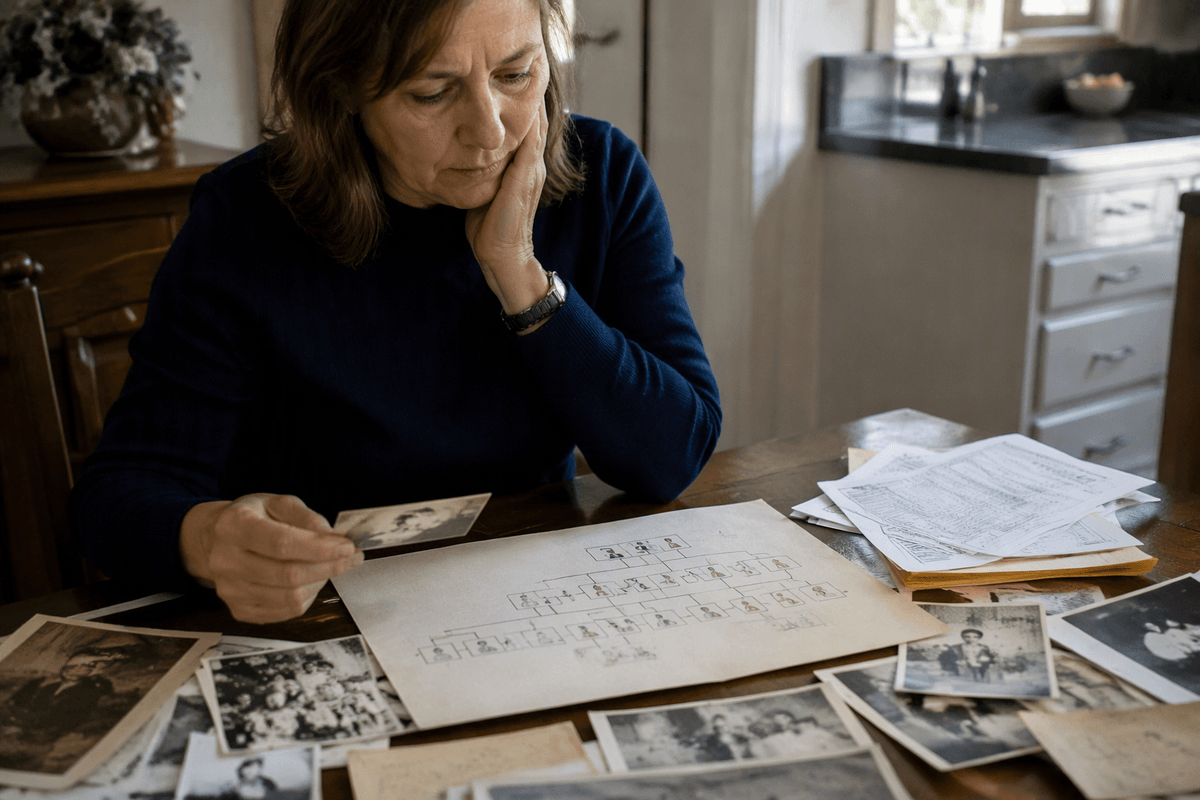
The process may begin with a small gap in the family history: perhaps a relative was once diagnosed with a serious illness, but the exact type is no longer clear. Details like that can make a family tree feel less like a complete record and more like a map with missing street names. Certain patterns still carry useful clues. When the same condition appears in several close relatives, such as parents, siblings, or children, on the same side of the family, the pattern may be more meaningful than isolated diagnoses scattered across both branches. Age at diagnosis also matters. A condition that develops unusually early in a relative may provide a stronger clue than one first identified much later in life.
Certain combinations of illnesses can also attract attention when they repeatedly appear within the same branch of a family. Multiple primary conditions in one person, such as separate diagnoses occurring at different points in life, may add further evidence that the pattern deserves a closer look. Even with several clues, however, family history can remain difficult to interpret. Adoption, smaller families, incomplete medical records, and vague or misremembered diagnoses may make a meaningful pattern appear insignificant, or make an otherwise ordinary pattern seem more concerning than it really is.
How inherited mutations create repeating risk signals
Sometimes the pattern is not dramatic at all. It may simply be the same family name coming to mind whenever a history of serious illness is discussed. When an inherited genetic variant is involved, that repetition may reflect a risk passed through one branch of the family and appearing across several generations. The pattern might involve the same type of illness affecting multiple relatives, or a recurring combination of related conditions that does not seem fully explained by the family’s shared habits or environment.
The signal becomes more meaningful when several clues appear together. An unusually early diagnosis, multiple close relatives with similar conditions, or more than one separate primary diagnosis in a single person may all point toward an inherited risk, even when the exact condition differs from one relative to another. Genetics does not produce a perfectly predictable pattern, however. Not everyone who carries a higher-risk variant will develop the associated illness, and some families may not show a clear pattern until the history is viewed across several generations. Looking at the entire family tree often provides a more useful picture than focusing on any single diagnosis.
When “negative” genetic results still leave uncertainty
The relief can arrive fast: the portal shows a “negative” result, and for a moment it feels like the family story should quiet down. Then a different thought follows—if the test was negative, why did two cousins on that same side have colon cancer before retirement? That’s the part many people don’t expect. “Negative” often means the lab didn’t find a specific inherited change on the genes they looked at, not that inherited risk is impossible.
Uncertainty can linger for practical reasons. The most telling person to test may be the relative who had cancer, and sometimes that isn’t possible. Some families have patterns that point to genes that weren’t included, or to changes science can’t confidently label yet. And sometimes the family pattern is real but comes from a mix of smaller genetic factors and shared exposures that don’t show up as a single clear mutation. So the history still matters—even when the report sounds definitive.
Direct-to-consumer results and the surprise anxiety spiral

The email subject line is cheerful—your results are ready—and you open it in the grocery store line, expecting a simple answer. Instead you get a risk chart, a few percentages, and a list of “variants” that reads like a warning label. For some people, that’s where the anxiety spikes: not because the information is clearly bad, but because it’s unclear what kind of information it even is. A “higher than average” estimate can feel like a diagnosis, while a “no increased risk found” can sound like permission to stop worrying, even when your family history still feels loud.
Direct-to-consumer testing also tends to land without context. It may cover only certain inherited changes, interpret results differently than a clinic, or miss the nuance of which relative had what cancer and at what age. Then the mind fills in gaps: one confusing line in a report starts to compete with years of family stories. The hardest part is the mismatch—confidence in the formatting, uncertainty in the meaning.
What family history can miss or distort over time
At some point, the family story starts to sound smooth—almost too smooth. “Everyone on Dad’s side gets cancer” becomes the shortcut, even if what really happened was one uncle with lung cancer after decades of smoking, a grandmother with late-life skin cancer, and a cousin whose diagnosis was never clearly named. Over time, details blur into categories (“stomach issues,” “female cancer”), and those labels can quietly change what the pattern seems to be. The ages are especially slippery; a diagnosis at 58 can get retold as “early 50s,” and that small shift can make a branch feel more suspicious than it is.
Family history also tends to undercount, not overcount. Relatives may not share diagnoses, some cancers are treated privately, and record-keeping can get messy after divorces, estrangement, adoption, or early deaths from other causes. On top of that, smaller families can hide a real inherited signal simply because there aren’t enough people for it to repeat. In the end, the “map” you’re working from is often incomplete—just convincing enough to worry, but not always detailed enough to be certain.
Turning history into decisions without false certainty
You can feel it when you try to translate the story into a checkbox: the form wants certainty, but your memory offers “maybe,” “I think,” and “it was something in her abdomen.” That mismatch is where people often overcorrect—either treating one scary diagnosis as destiny, or treating a “negative” result as a full erase. Family history works better as a set of weights than as a verdict: which side of the family, how close the relatives are, what the cancer types actually were, and whether ages at diagnosis were noticeably younger than expected.
In practice, decisions tend to get made with imperfect inputs. A cleaner list—who had what, at what age, and whether it clusters on one branch—can change the next conversation more than a vague “it runs in the family.” Sometimes the most useful shift is accepting “higher suspicion” as a workable category, without needing it to become certainty.