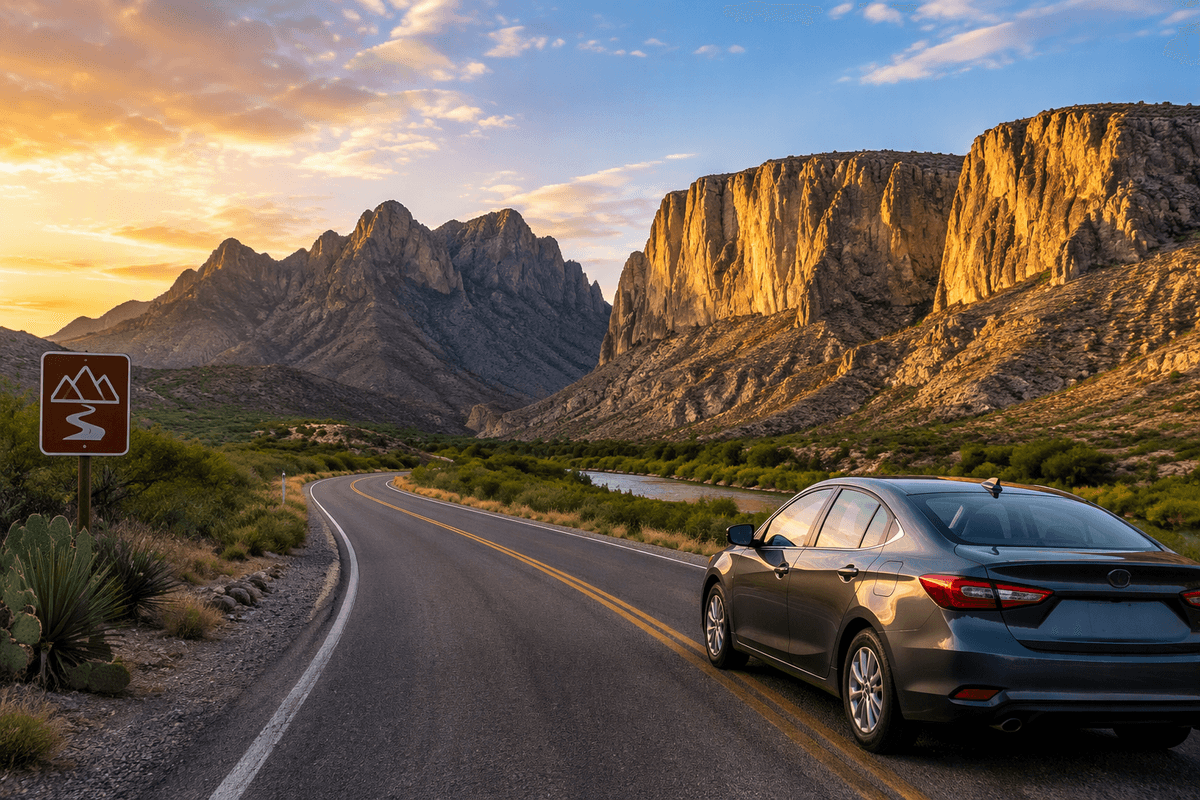
Big Bend expectations with a regular car
The first real decision at Big Bend usually happens before you even turn the key: do you treat the park like a paved-scenic-drive destination, or do you start “seeing where that dirt road goes” because the map makes everything look equally reachable? In a sedan (or anything low and long), the winning expectation is simple: you can have an excellent, full-feeling first visit without chasing backcountry routes—and you’ll enjoy it more if you stop measuring the trip by what you can’t drive.
On paved roads, Big Bend is remarkably generous. You can commit to the 30-mile Ross Maxwell Scenic Drive all the way out to Castolon and Santa Elena Canyon, then stretch your legs on the short Santa Elena Canyon walk, and still have time for easy, high-payoff stops like the Window View Trail and the Fossil Discovery Exhibit. That’s desert, canyon, and mountain scenery without white-knuckle miles or undercarriage math.
Where people get burned is the middle category: “improved” dirt roads. They’re often fine for most vehicles, until a storm rearranges the surface into sand, mud, or ruts—sometimes overnight. The far end of the spectrum is not negotiable: primitive routes like Old Ore Road and Black Gap Road are described as extremely rough and unsuitable for passenger cars, minivans, and RVs, and the park’s definition of the required vehicle is a true high-clearance 4WD setup. A breakdown out there isn’t just inconvenient; it can be life-threatening, which is why checking current conditions before you gamble on any unpaved road isn’t optional—it’s the plan.
Paved-road highlights you can confidently reach
The moment you stop treating the park map like a menu of equal-effort options, the paved-road “hits” get surprisingly straightforward. Santa Elena is where the paved plan really proves itself. The canyon walk is short (1.4 miles round-trip), but it delivers that “I’m inside Big Bend now” feeling fast—especially if you time it earlier or later in the day to avoid the busiest stretch of the parking area. The trade-off is that this west-side out-and-back can eat a large chunk of your daylight just in driving, so it helps to treat the stops along Ross Maxwell as your itinerary rather than detours.
To balance the desert-and-canyon scale with something easy and close, pair it with two low-effort wins: the Window View Trail in the Chisos (a 0.3-mile loop) and the Fossil Discovery Exhibit. They’re both paved-access friendly, and they round out the day without asking your sedan to “try harder” than it should.
One-day, sedan-friendly plan (NPS-inspired)
The hardest part of a one-day Big Bend plan in a sedan isn’t finding enough to do—it’s resisting the urge to “just add one more road” once you realize how far everything is. If you treat the day like a single loop with one major drive, the logistics calm down fast.
A solid NPS-inspired rhythm is: start with the Chisos for the Window View Trail (0.3-mile loop) while temperatures are still reasonable and your legs feel fresh, then commit your windshield time to the Ross Maxwell Scenic Drive (30 miles of pavement) as the backbone of the day. The west-side stops work well because they’re scenic without requiring you to leave the road network; the trade-off is that it’s an out-and-back feeling if you keep checking the clock.
Save the Santa Elena Canyon walk (1.4 miles round-trip) for later in the drive—big payoff, low complexity—then finish with the Fossil Discovery Exhibit if you want something easy when the heat or fatigue starts winning. What doesn’t work is squeezing in “quick” dirt-road detours without checking conditions; after rain, that’s how a simple day turns into a recovery plan.
Improved dirt roads: when they’re okay
I tried to “just sample” an improved dirt road in Big Bend, the plan sounded harmless: a few miles out, a few photos, back to pavement. What changed the decision wasn’t bravery—it was the surface. Improved dirt can feel sedan-friendly when it’s hard-packed and recently graded, but it has a short fuse: one storm can turn a normal-looking track into soft sand, sticky mud, or ruts that suddenly make your clearance (and your spare tire) the limiting factor.
As a rule, improved dirt roads are the only unpaved category I’ll even consider in a standard car—and only when the park says conditions are good. Big Bend explicitly notes that these roads are generally accessible to most vehicles, but can deteriorate rapidly after storms, so you should ask about current conditions before committing. The trade-off is simple: you might save the “extra” driving of sticking to pavement, but you’re taking on more uncertainty with fewer easy turnaround points.
If you do try one, keep it short and reversible: go slowly, avoid puddles you can’t read, and treat the first stretch as a test. The moment you see sand building up, ruts deepening, or tire tracks weaving to dodge obstacles, that’s your cue to call it and head back while it’s still easy.
Dagger Flat Auto Trail: typical access, real caveats
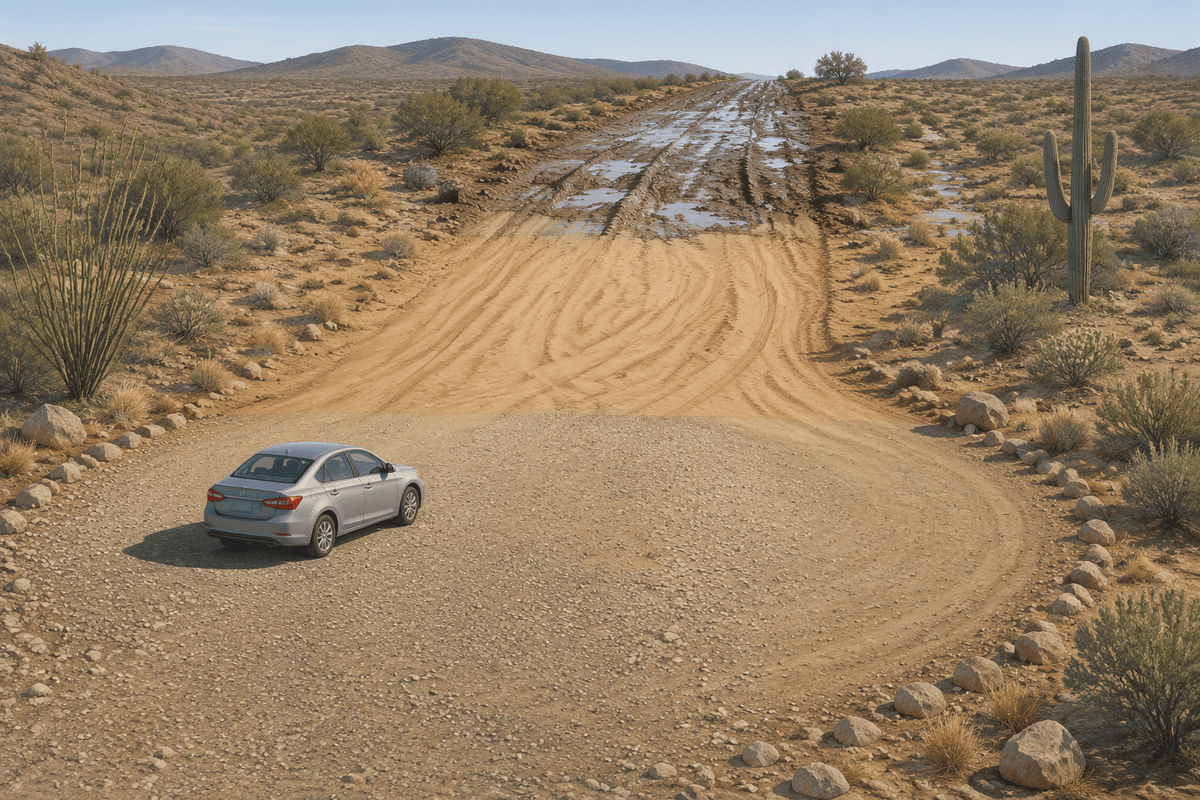
Dagger Flat Auto Trail is the kind of road that tempts sedan drivers because it’s usually in the “okay” bucket: the park describes it as typically open to most vehicles. That “typically,” though, is doing real work. When it’s firm and dry, it can feel like a low-stress way to add a desert-side detour without committing to true backcountry travel.
The caveat is that Dagger Flat is still an improved dirt road, and it shares the same failure mode as the rest of that category: seasonal sand and post-rain mud can turn it from casual to difficult—or outright impassable—fast. In a low-clearance car, your practical decision point isn’t “Can I see the start?” but “Can I turn around easily if the surface changes in the next mile?” If the road looks soft, rutted, or recently wet, treat it as a no-go and spend that time on guaranteed pavement instead.
Primitive roads that require true high-clearance 4WD
The friction point with primitive roads is that they don’t always look dramatic at the turnoff. You’ll see a narrow track and think, “Maybe just a mile.” But Big Bend’s primitive routes are where the park stops speaking in hints and gets literal: roads like Old Ore and Black Gap are described as extremely rough and explicitly unsuitable for passenger cars, minivans, and RVs. If you’re in a sedan or small crossover, the right move isn’t to “try the first bit”—it’s to treat the sign as the turnaround.
Part of what makes this category non-negotiable is that “4WD” here doesn’t mean an AWD rental with street tires. The park’s baseline for primitive dirt roads is a true high-clearance 4WD SUV or truck with a low-range transfer case, at least eight inches of ground clearance, and at least 15-inch tire rims. That’s a different machine than what most first-timers arrive in, and the trade-off is simple: you either commit to the right vehicle and self-reliance, or you keep your trip anchored to pavement and leave the backcountry to another visit.
Because once you’re out there, the risk isn’t just a rough ride—it’s isolation. A disabled vehicle on these roads can turn serious fast, especially with heat and limited traffic, which is why this is the “don’t attempt” bucket, not the “be careful” one.
Safety checks before you drive anything unpaved
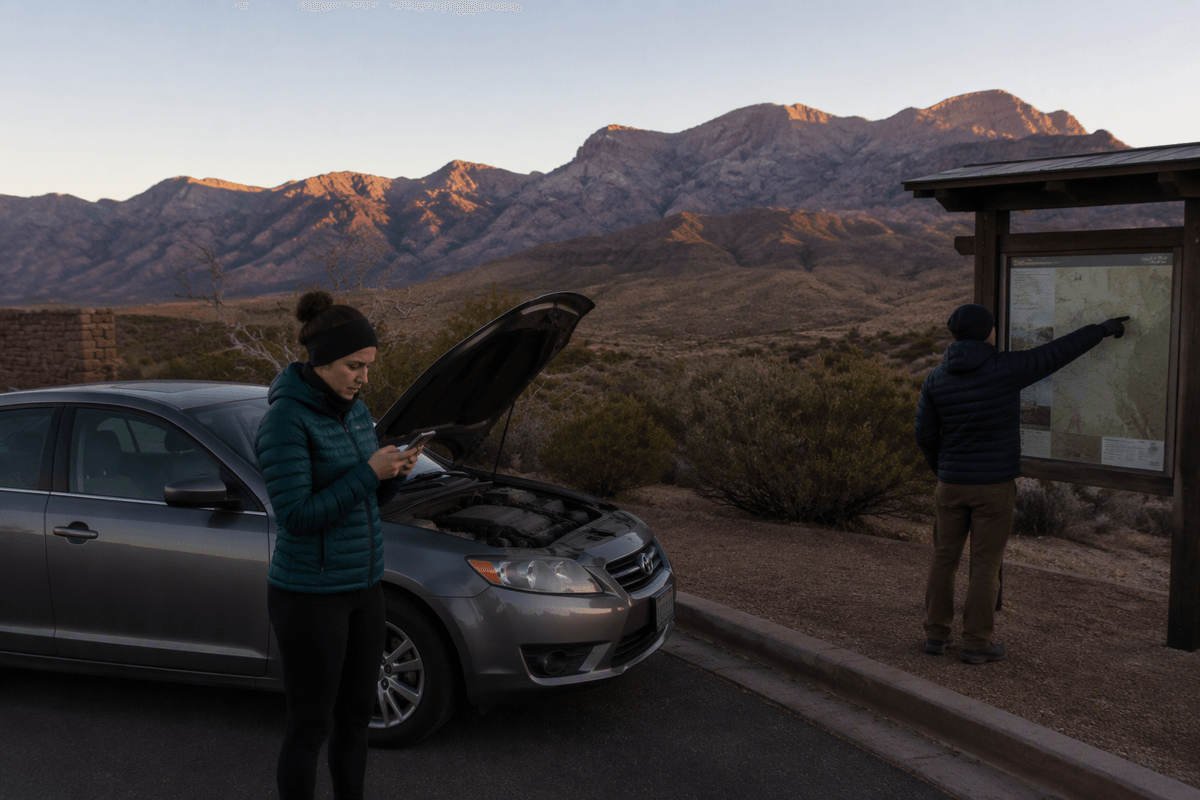
The moment you’re tempted to leave pavement, treat it like a pre-flight check, not a vibe check. Before you even roll onto an improved dirt road, pull up Big Bend’s current conditions/alerts and then confirm at a visitor center what’s changed since the last storm—because “accessible to most vehicles” stops being true fast when a washout, sand drift, or mud patch shows up overnight.
Then do the unglamorous car stuff that actually decides your day: start with a full tank (distances are big and “I’ll fuel later” can backfire), make sure you have a real spare and the tools to use it, and set a hard turnaround rule. If the surface turns soft, rutted, or you can’t see how deep a puddle is, don’t negotiate—reverse the decision while it’s still easy.
Finally, pack like a breakdown is possible: extra water and basic emergency gear. The park is blunt about how isolated backcountry roads can be; a disabled vehicle out there can become life-threatening, which is why the safest sedan strategy is to make “conditions check + quick exit plan” part of every unpaved mile.
Wrap-up: a great Big Bend trip without 4WD
The last temptation usually hits when you’re tired and the light is getting good: one more dirt-road turnoff, just to “see what’s out there.” In Big Bend, that’s where a sedan-friendly trip can slip into an unnecessary risk. If you’ve already done the paved backbone—Ross Maxwell out to Castolon and Santa Elena, a quick reset in the Chisos at Window View, and the Fossil Discovery Exhibit as an easy closer—you’ve covered a genuinely complete first visit without forcing your vehicle to audition for a different job.
The wrap-up rule I keep coming back to is simple triage: paved is your default, improved dirt is a bonus only when conditions are confirmed good, and primitive roads are a hard no unless you’re in a true high-clearance 4WD. The trade-off isn’t about being “adventurous”; it’s about choosing certainty in a park where storms can change surfaces fast, and where a breakdown on an isolated backcountry road can escalate from inconvenient to dangerous.
If you want one practical takeaway, make it this: check current conditions the same day you drive, pick a paved highlight as your non-negotiable anchor, and let any unpaved mile earn its place by being dry, smooth, and easy to reverse. Big Bend rewards that kind of disciplined planning—and your trip will feel bigger, not smaller, for it.