Your raise lands, and the plan feels fuzzy
The deposit hits and, technically, everything is fine. The number in your checking account is bigger, but it doesn’t come with instructions. A few months ago, “save more” felt like a clear answer; now it’s competing with real wants, overdue fixes, and the quiet fear that you’ll waste the best window to get ahead.
The fuzzy part usually isn’t motivation—it’s measurement. Payroll withholdings changed, benefits may have reset, and the raise isn’t a clean “extra” amount. Meanwhile, your baseline spending is already shifting: a better apartment, more takeout on late work nights, a couple subscriptions that suddenly seem justified. Before you pick goals, you need to see what actually changed and what’s already getting absorbed.
The first paycheck: what you expected to improve

That first higher paycheck tends to arrive with a private script: the car repair stops being a crisis, the credit card balance finally starts falling, the “I should invest” voice gets quieter because you’ll “do it next month.” Then the stub shows a smaller net jump than the headline raise, and the gap between expectation and reality is where people start improvising.
Instead of guessing, treat the first paycheck like a one-time audit. Compare this pay period’s net pay to the last “normal” one, then back out any non-repeat items (new 401(k) contribution, benefit premium changes, bonus, one-off overtime). What’s left is the baseline increase you can count on. Now write down what you expected to improve in the next 30 days—specifically. “Less stress” becomes “$300 buffer so I don’t float groceries,” or “$200 extra to the highest APR card,” or “raise 401(k) by 2%.” If it’s not schedulable, it’s probably just vibe spending.
Give those expectations dates. If your rent reset next month or an annual insurance bill is due, the paycheck can’t do everything at once, and forcing it will make the plan feel broken.
Then life upgrades by default, not by choice
A week or two after the paycheck audit, the creep usually shows up in places that don’t feel like “splurges.” The group dinner becomes routine, the rideshare replaces the bus “just for this month,” the premium phone plan quietly renews, and a nicer gym suddenly looks reasonable. None of it is dramatic, but it’s recurring—so it claims the raise before any debt payment or investing change has time to stick. If rent is resetting soon, or a car insurance premium is due, the timing makes the drift feel like it’s “out of your control,” even when the pieces were optional.
The tell is when decisions stop being single purchases and start being subscriptions, higher fixed bills, or convenience habits. Those are harder to reverse, and cancellation friction is real: a lease, a contract, a social routine. A $40 upgrade is small once; it’s not small 12 times.
For a month, treat every new recurring expense as provisional. If it can’t survive a 30-day pause—or fit inside a pre-set “upgrade allowance”—it’s probably not an upgrade, it’s the raise getting auto-assigned.
Calculate the real “extra” money you control
After the “provisional month,” the next move is subtractive, not aspirational. Take your last 30 days of actual spending and re-label it into two buckets: locked costs (rent, minimum debt payments, insurance, commuting, childcare) and flexible costs (food out, shopping, travel, convenience). Now compare that to your new monthly net income. The difference is the only number that deserves to be called “extra,” and it’s usually smaller than the raise headline because lifestyle creep already claimed part of it.
Then stress-test it once, on paper. Pull forward the near-term spikes you already know are coming—annual renewals, a car maintenance month, a wedding weekend, a higher utility season. If those would push the “extra” below zero, it isn’t extra yet; it’s a timing gap. This is where a lot of plans fail quietly: the budget works in an average month, then collapses on an expensive one.
What remains is your controllable surplus. Split it into two lines: “automatic” (the amount you can route every payday without thinking) and “floating” (the amount you’ll decide on monthly). If a dollar can’t be automated, it’s the first dollar that disappears.
Create a buffer so progress survives bad weeks
The first time an “expensive week” hits after you’ve set new transfers, the plan usually gets tested in the most boring way: a tire, a dentist copay, a work trip you get reimbursed for later. If the only cushion is your checking balance, you’ll either pause the debt/investing move “just this month” or put the surprise on a card and tell yourself it doesn’t count. Either way, the raise starts feeling unreliable.
So build a buffer that sits between life and your goals. A practical target is one month of locked costs, held in a plain high-yield savings account, separate from your long-term emergency fund. Fund it with the first slice of controllable surplus until it’s full, even if that slows investing for a few pay periods. The constraint is timing: the buffer is there to cover a bad week without touching the automation.
Once it’s funded, treat it like a self-repairing feature. Any time you dip below the target, the next month’s “floating” money refills it before upgrades, extra payments, or new contributions. Progress stops being fragile.
Debt or investing next? Use a clear rule
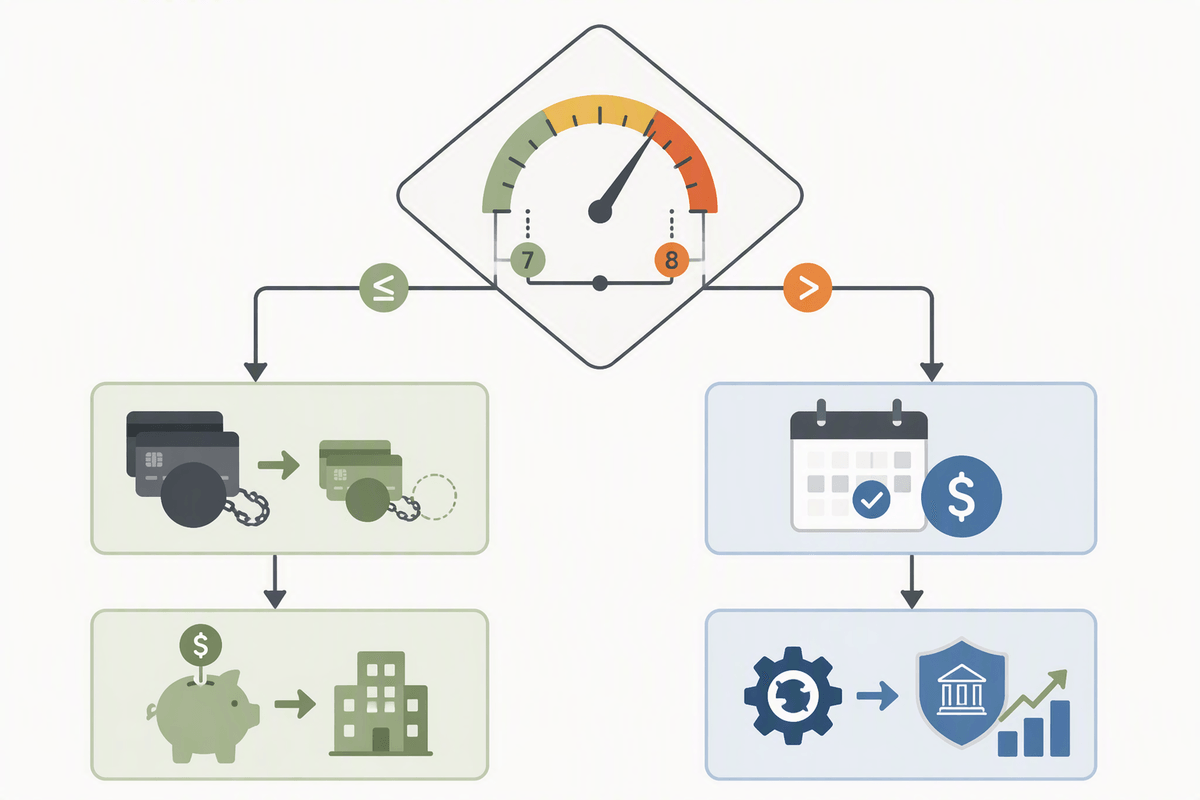
With the buffer in place, the next fork is where people start second-guessing themselves: send the new money at debt to “lock in” a return, or invest so you don’t miss compounding. The friction is that both feel responsible, and the wrong choice only becomes obvious later—usually after a rate change, a market dip, or a month where cash is tighter than expected.
A clean rule keeps it from becoming a weekly debate. If any debt is above about 7–8% APR (and it isn’t a mortgage you’re keeping for other reasons), treat that like a priority investment and pay it down aggressively while still taking any employer match in retirement accounts. If your remaining debt is below that range, keep minimums and route the controllable surplus into tax-advantaged investing (401(k)/IRA) on autopilot.
The constraint that makes this work is pacing: re-run the rule any time a promo APR expires, a loan gets refinanced, or your “floating” money shrinks. The goal isn’t a perfect answer—it’s fewer reversals.
Keep lifestyle upgrades, but cap them on purpose
Once the debt-versus-investing call is automated, the urge to “finally enjoy it” gets louder—and it’s not irrational. The failure mode is letting enjoyment become a set of new fixed bills that quietly outrank your plan. A cleaner approach is to approve upgrades, but only inside a hard monthly cap that’s smaller than the surplus you just fought to measure. If your controllable surplus is $600, an upgrade cap of $100–$200 keeps the raise feeling real without turning it into a lease, a payment plan, and three new subscriptions.
Make the cap operational, not aspirational: one separate “upgrade” category, one number, and one rule that it never borrows from the buffer or the automated transfers. When the cap is hit, the decision becomes timing (“next month”) instead of judgment (“am I being irresponsible?”). You still get lifestyle lift, but compounding and payoff don’t get renegotiated every time life gets tempting.
Recheck monthly and reroute when life changes
A month later, the plan either feels boring (a good sign) or it feels like it “should” be working but somehow isn’t. Treat that as a calendar problem, not a character flaw. On the same day each month, pull three numbers: current buffer balance versus target, total debt balances, and the last 30 days of flexible spending. The constraint is time—this needs to take 15 minutes, or it won’t happen when work gets busy.
Then reroute on purpose when life shifts: rent changes, a promo APR ends, childcare starts, a partner’s income dips, a medical bill shows up, a bonus hits. Keep the automation, but adjust the split. If “floating” money shrank, refill the buffer first and reduce the upgrade cap before you touch minimums or employer match. The goal isn’t perfection; it’s fewer surprise months where the raise disappears without a decision.