Why “just cut it off” feels reasonable
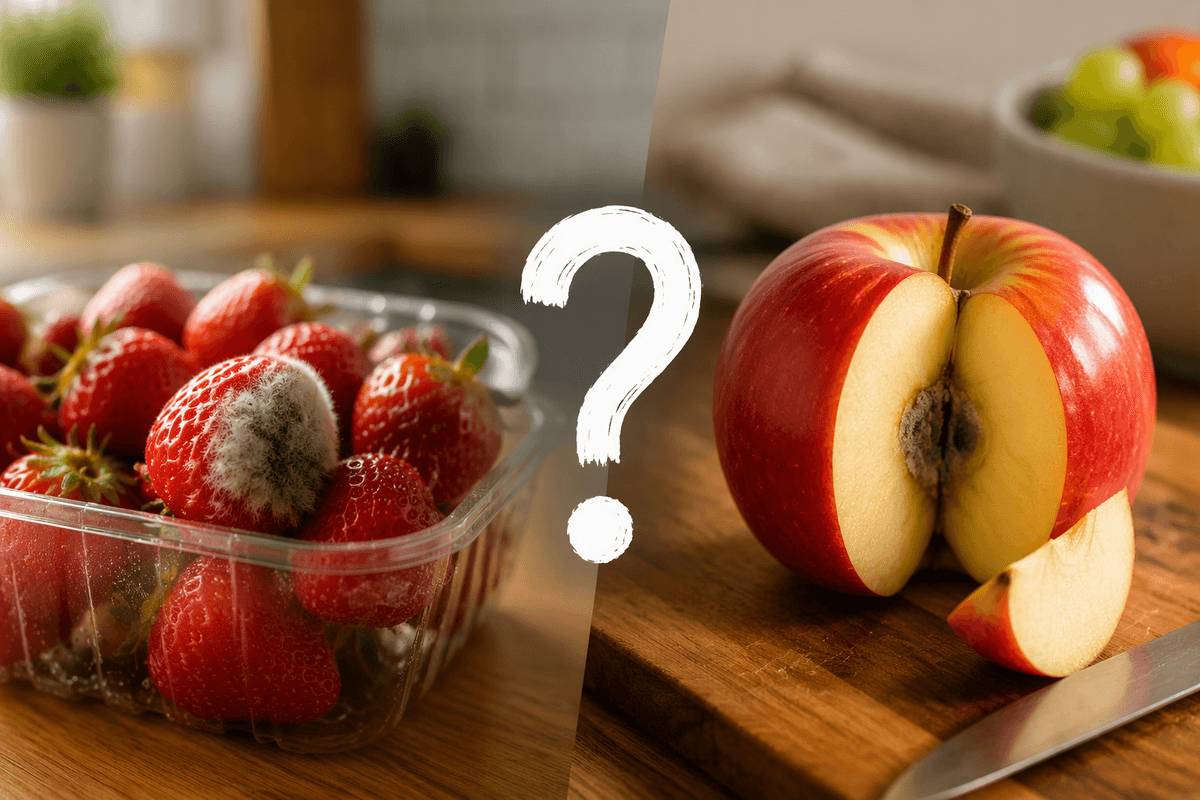
You’re standing at the counter with a berry clamshell open, and the mold is small enough to feel negotiable. A quick trim seems tidy: remove the bad bit, save the rest, move on. It’s the same logic that works with a bruised apple or a brown spot on a banana—cut around the flaw and you’re back to “normal.” In a busy kitchen, that’s a satisfying trade: less waste, less fuss, and no dramatic decision over a single fuzzy dot.
What makes this feel so reasonable is that mold looks localized. It has edges you can see, and fruit feels like a solid object you can edit. But fruit isn’t uniform; it’s full of tiny pockets of juice and air, and it changes fast once it’s warmed, bumped, or sitting too long. That’s where the confidence gets shaky: the spot you can see may be the last part of the problem to show up.
How mold spreads beyond the visible fuzzy spot
The first surprise is how ordinary the “fine” parts can look. You lift a berry and it still shines, but it’s a little softer than yesterday, and the bottom of the container feels damp. That’s often when people assume the mold hasn’t traveled—because the fuzz is only on one side. The catch is that the fuzzy patch is usually the part that’s easiest to see, not necessarily where the growth stops.
Mold doesn’t behave like a stain that sits on the surface. As fruit warms on the counter, gets jostled in a bag, or bruises in the fridge drawer, the flesh becomes easier to move through. On softer fruit, mold can send threadlike growth into nearby tissue and follow tiny cracks, juice channels, and bruised spots long before a second fuzzy dot appears. That’s why “one spot” can pair with other signals—leaking juice, a faint musty smell, or a cluster of slightly collapsed berries—that hint the spread is already wider than the trim line.
Soft fruit versus firm fruit: meaningful differences
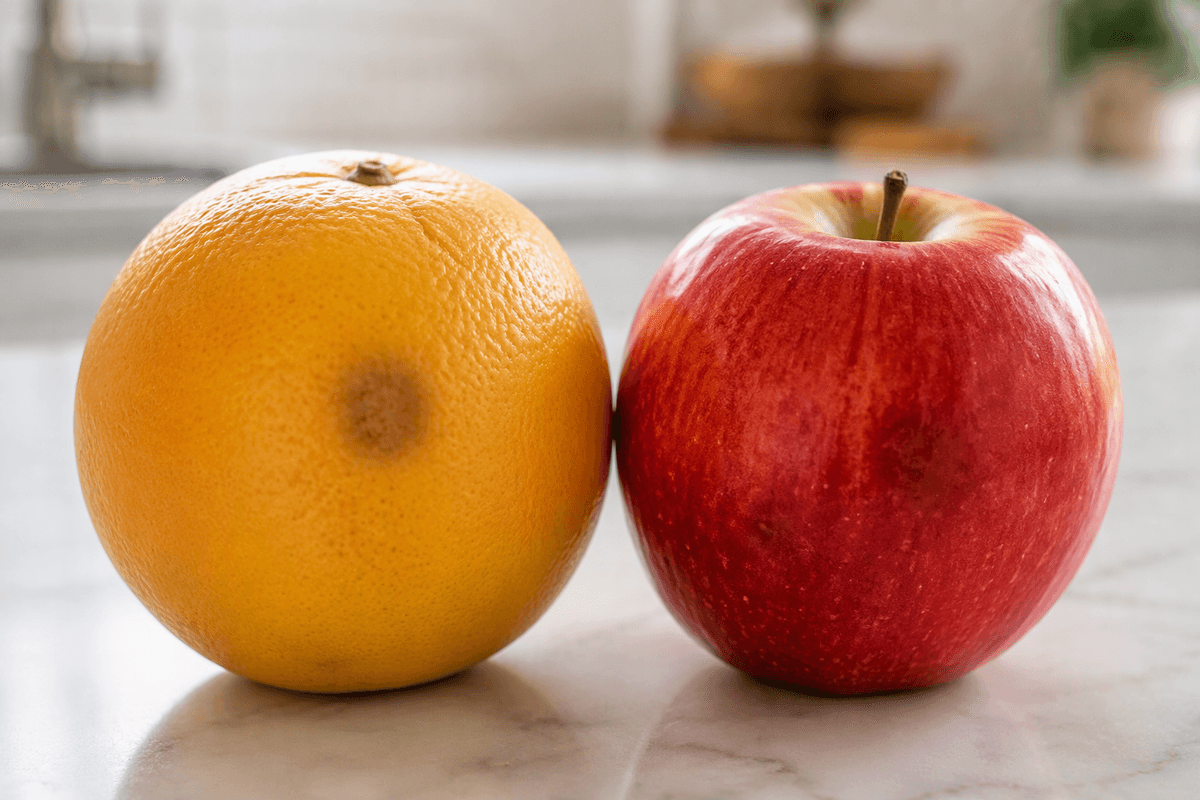
You notice it when you rinse the fruit: raspberries slump in your palm, while an apple stays crisp and almost squeaks under the knife. That texture difference is more than convenience. Soft fruit—berries, peaches, ripe pears—has thin skin and tender flesh that bruises easily. Once a berry is slightly crushed or a peach has a dent, the juicy tissue becomes a shortcut for mold to move through, even if the fuzz still looks “small.” The softness and ripeness can hide how far things have changed beneath the surface.
Firm fruit tends to fail more slowly. A thick peel on citrus, or dense flesh on apples, can limit how quickly mold spreads inward, so a blemish may stay closer to one area—especially if the fruit still feels solid, smells normal, and isn’t leaking. But “firm” isn’t a guarantee. A tiny puncture, a stem scar, or a soft pocket you only find when slicing can act like an entry point, turning a confident trim into a guess that only looks neat on the cutting board.
Mycotoxins, bacteria, and the hidden uncertainty
Sometimes the fruit passes the “looks fine” test and still makes you pause—maybe the smell is only slightly off, or the cut surface looks wetter than it should. That’s where the conversation shifts from fuzz to what you can’t confirm at home. Some molds can leave behind mycotoxins—chemical byproducts that don’t reliably disappear when you rinse or trim. And moldy, leaking fruit also becomes a friendlier place for bacteria to multiply, especially where juice has pooled in a clamshell or a bruise has turned the flesh translucent.
None of this is visible in a clean slice. You can remove the obvious spot and still be guessing about what moved through microscopic cracks, stem scars, or soft pockets. The risk isn’t the same for every fruit or every mold, but the uncertainty rises fast when the fruit is already slumping, wet, or starting to smell “fermented” rather than simply ripe.
When trimming creates confidence but not safety
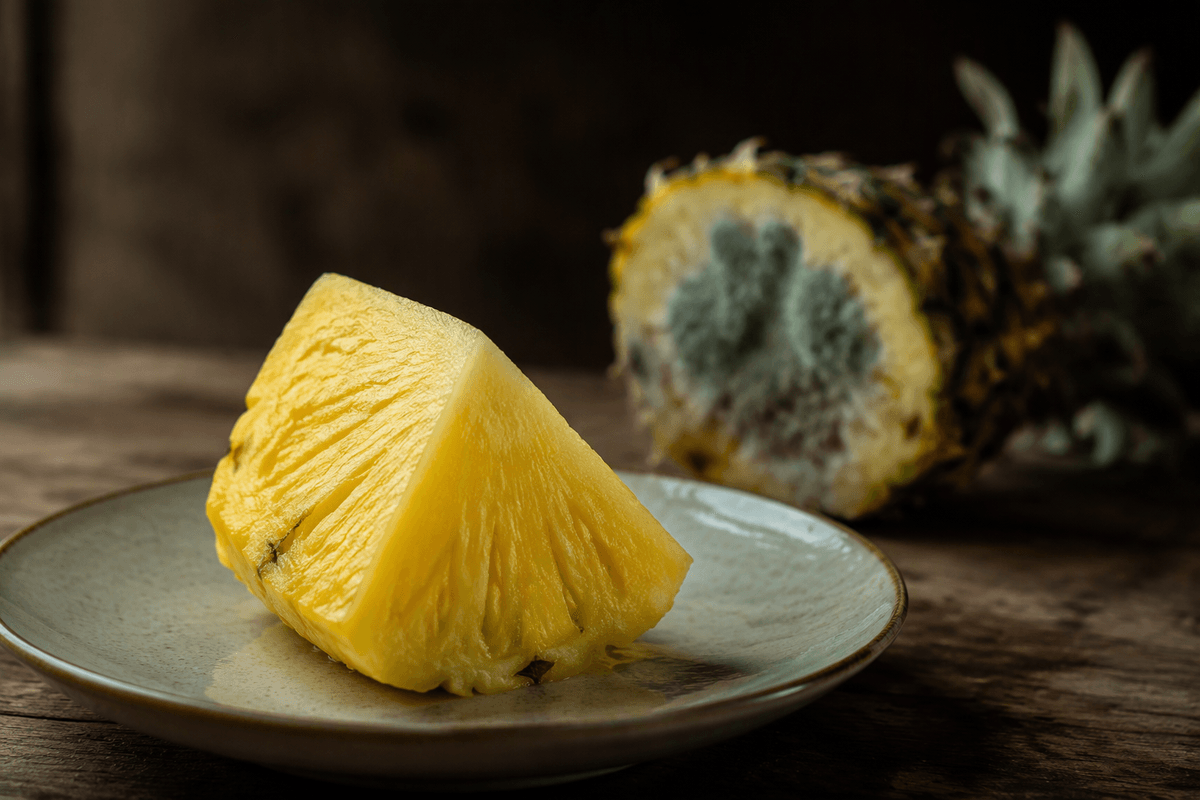
The knife makes it feel settled. You cut a clean wedge out of an apple, or shave a thin circle around a moldy spot on citrus, and what’s left looks bright and edible—no fuzz, no discoloration, no drama. That visual reset is powerful. It turns a messy, uncertain problem into something you can “fix” with a straight line.
But trimming mainly changes what you can see, not what you can verify. On fruit that’s already softening, leaking, or smelling even faintly musty, the mold’s reach may not match the border on your cutting board. And even on firmer fruit, the tidy cut can hide the riskier pathways: a stem scar, a small puncture, a soft pocket you didn’t notice until you sliced through it. Your confidence often increases at the exact moment the evidence gets thinner—because a neat piece of fruit doesn’t show what traveled through it earlier.
Situations that raise stakes: allergies, kids
You don’t always realize the “stakes” changed until you’re portioning fruit for someone else. The same trimmed apple that feels like an acceptable gamble for you can feel different when it’s headed into a lunchbox, a toddler bowl, or a smoothie for someone who’s already queasy. In those moments, the little unknowns matter more: a berry that was only slightly damp, a faint musty note you can’t quite name, a clamshell with one collapsed corner.
That’s because the downside isn’t just “wasting fruit” anymore. If someone has mold allergies, a sensitive stomach, or is very young, the margin for error may be smaller—even when the mold spot looks minor. And the tricky part is that the reassuring cues (a clean cut surface, no visible fuzz) don’t resolve the earlier uncertainty about where growth or byproducts may have traveled, especially in soft fruit that bruises easily.
A practical decision lens for low-waste choices
The moment you tip the clamshell and a little juice gathers in the corner, the decision stops being about the one fuzzy dot. It becomes about patterns: softness that’s new since yesterday, a berry that collapses when you pinch it, a smell that reads even slightly musty or “winey,” moisture that keeps returning after you dab it. Those aren’t dramatic signs, but they’re the ones that quietly suggest the fruit has been changing in places you can’t see, which makes trimming feel precise while the situation underneath is not.
A low-waste lens can still be practical without pretending you can prove anything. If the fruit is firm, dry, and normal-smelling—and the blemish is truly isolated—trimming can be a reasonable bet because the structure slows spread. If the fruit is soft, bruised, leaking, or the container has multiple compromised pieces, it’s less about being strict and more about acknowledging the uncertainty you’re buying. When the cues are mixed, many people find it helps to treat “eat raw” as a higher bar than “discard,” and to trust the small signals you’d usually talk yourself out of.