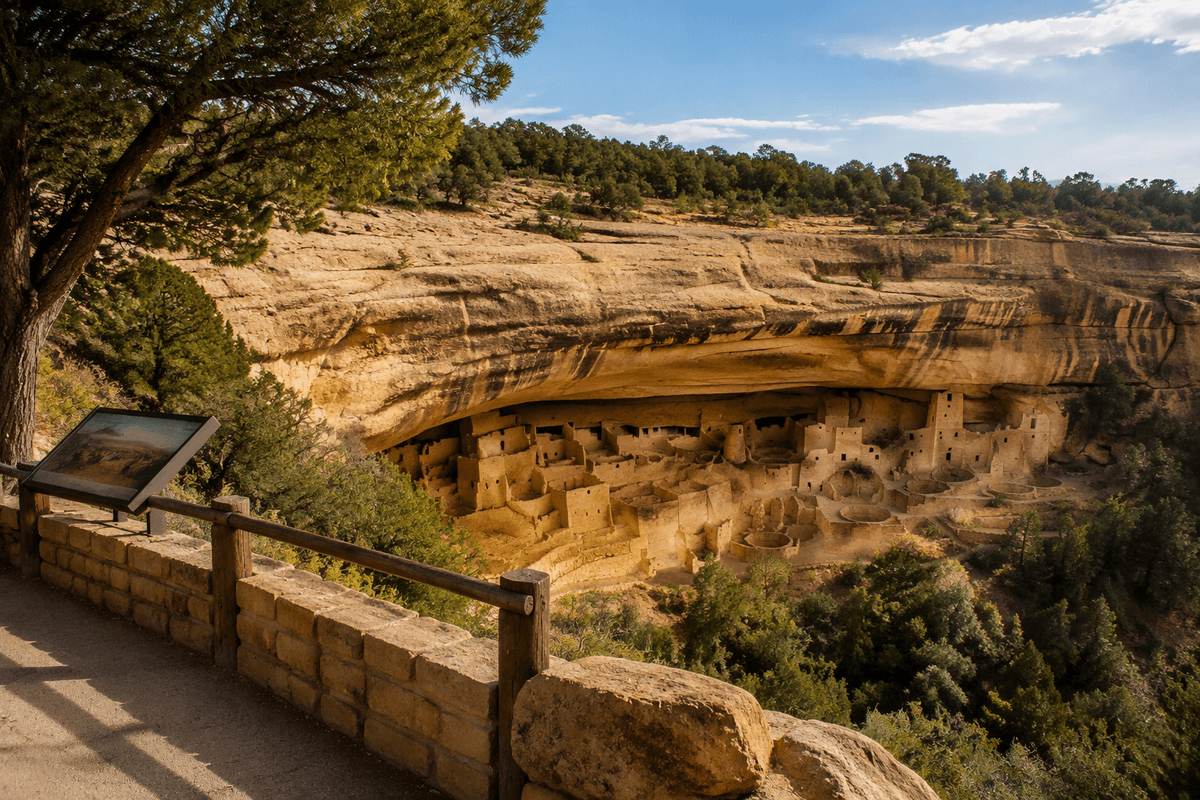
What “seeing cliff dwellings” really means at Mesa Verde
The first small reality-check at Mesa Verde is that “seeing cliff dwellings” can mean two very different experiences: viewing them from overlooks and short paved paths, or actually entering them. If one of you has limited mobility and the other dislikes heights, it’s smart to plan around the first definition—because the park’s headline interiors come with exposure and climbing.
The most reliable way to still feel like you “got” Mesa Verde is to treat the Mesa Top Loop Road as your main event: a self-guided drive with short paved trails to a dozen ancestral sites and viewpoints, including overlooks where you can see major dwellings like Cliff Palace from Sun Point. It’s also the park’s most accessible ancestral-site area, which matters on a one-day pass-through when energy and time are finite.
What you’re choosing to skip is entry: Cliff Palace and Balcony House are ranger-tour only, and both involve tall ladders and steep cliff stairs. And Spruce Tree House—often on people’s must-see list—remains closed, so the “worth it” version for this trip is the museum-area covered porch view, not a walk into the dwelling itself.
Where ladders are required (and why)
The moment you start weighing “maybe we’ll just do Cliff Palace,” the ladder question stops being theoretical. Cliff Palace and Balcony House are ranger-guided entries only, and both involve tall ladders plus stone steps carved into steep cliff faces—exactly the mix that can turn a one-day visit into an anxiety-and-knees negotiation instead of an experience.
Those ladders aren’t a gimmick; they’re basically the architecture of access. The dwellings sit recessed in alcoves, so the routes in and out follow narrow, steep terrain that the park can’t (and shouldn’t) tame into a gentle path without changing what’s being protected. If either of you dislikes heights, treat the tour requirement as a clear decision gate: plan to “see” these places from Sun Point and other overlooks instead. It’s less immersive than stepping inside, but it’s also predictable, lower exertion, and doesn’t hinge on whether you feel steady on rungs that day.
Mesa Top Loop Road: the most accessible ancestral-site area
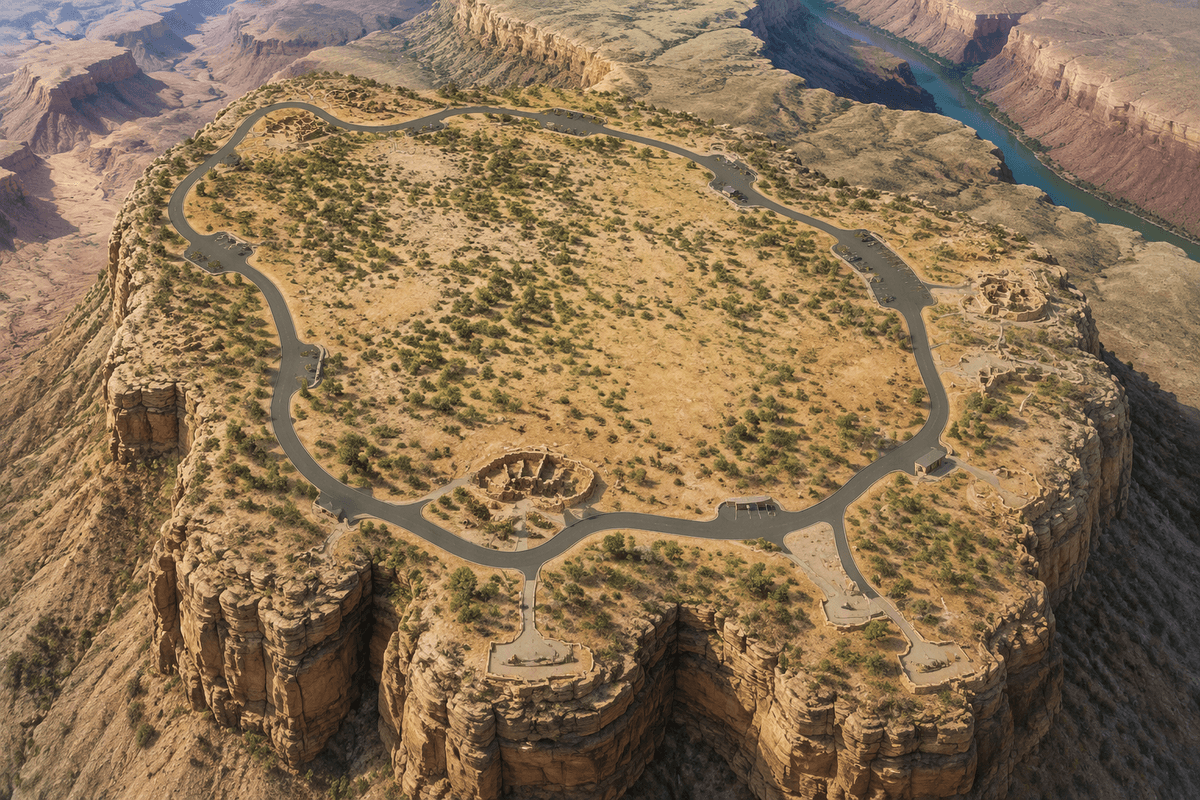
The first time you commit to Mesa Top Loop Road, the decision feels almost too easy: it’s a 6-mile self-guided drive that lets you keep the day moving without gambling on ladders, tour times, or how steady your knees feel after lunch. What works especially well for a one-day pass-through is the rhythm—park, walk a short paved segment, look, read a bit, and get back in the car before fatigue snowballs. The limitation is that “short” still isn’t always “flat,” so if mobility is variable, you’ll want to cherry-pick stops rather than force yourselves to “complete” the loop. citeturn2search0turn2search1
The park is explicit that this is its most accessible ancestral-site area, and it’s built for self-guiding: paved trails at key points, restrooms along the loop, and interpretive support like an audio tour/guidebook so you can absorb the context without standing on your feet too long. If heights are a stress point, this is also where you can keep control—many viewpoints feel open and airy, but you can often get a meaningful look from a spot that doesn’t put you right at the edge. citeturn2search1turn2search0
If you want one “anchor” view that still reads as iconic, aim for Sun Point View: you’re looking across to Cliff Palace without the exposure of entering it, and you can decide in real time how close to the rail feels comfortable. Pair that with stops like Sun Temple to balance cliff-dwelling spectacle with surface-site perspective—more walking than a pure overlook, but usually less psychologically taxing than anything involving vertical access. citeturn2search0turn2search3
Cliff-dwelling views without entry: Sun Point and Spruce Tree House porch
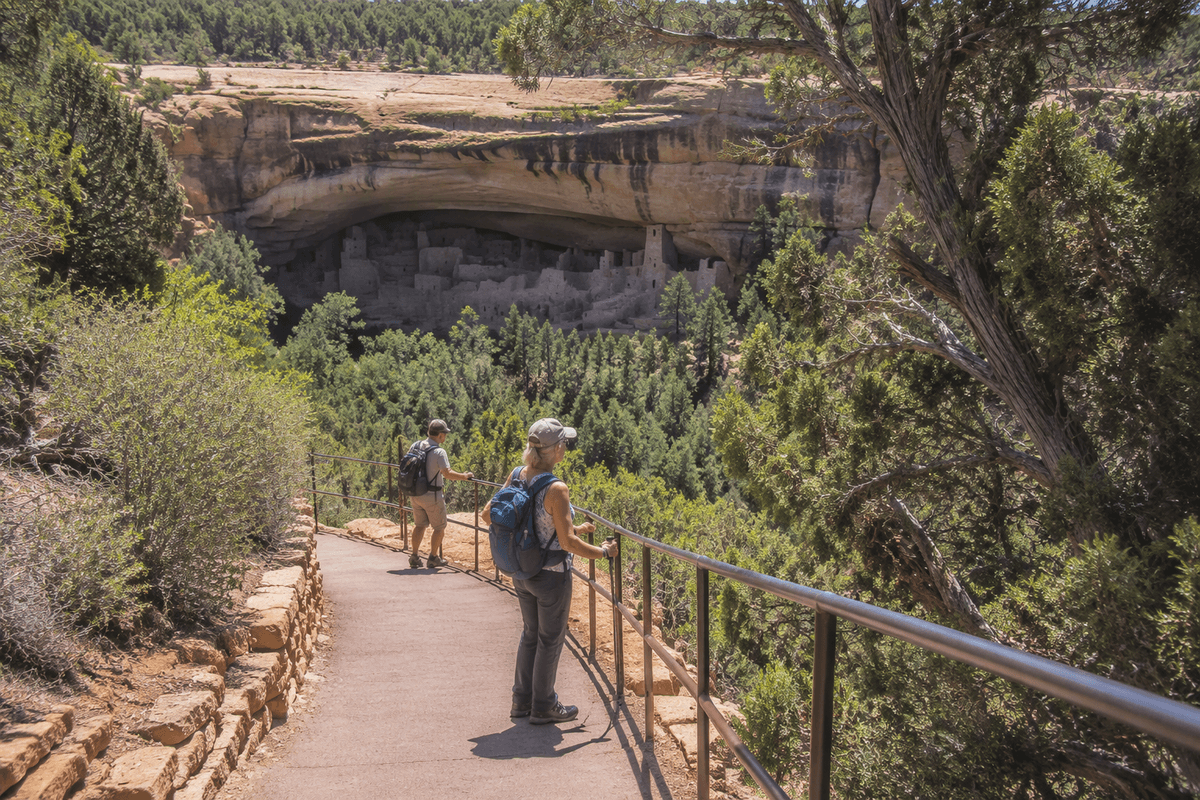
At Sun Point View, the trick is to treat the overlook like a dial, not a dare. You can get the “yes, that’s Cliff Palace” moment from well back, then decide how close to the rail feels steady—especially if one of you gets uneasy with open edges. What works here is that you’re looking across the canyon rather than negotiating down into it, so the view delivers the scale without the ladder-and-exposure commitment. What doesn’t work as well is detail: you’ll read the architecture more as a whole composition than as individual rooms.
Spruce Tree House is the other key “see it without entering it” stop—but with a big constraint: it’s still closed due to rockfall concerns. The version that makes sense for limited mobility is the covered porch near the museum, where you can look out with shade and a place to pause, and still feel anchored in the site’s history. There is a closer overlook, but it’s reached by a paved path that’s steep enough to be a real question mark if knees, balance, or endurance are variable.
If you’re choosing between the two, Sun Point is the cleaner, lower-effort cliff-dwelling view; Spruce Tree’s porch is the more comfortable stop when you want context and a reset, even if the dwelling itself is slightly more “distant” than people expect.
Start at the Visitor & Research Center and museum access points
The place that made our day feel organized instead of improvised was the Mesa Verde Visitor & Research Center. It’s open year-round and set up for low-friction access—accessible parking, paved approaches, and exhibits you can actually engage with even if one of you can’t stand long or the other doesn’t want to lean into railings at overlooks. If you’re deciding whether to commit to the long drive up to the mesa, this is where you can sanity-check conditions, closures, and whether your “no ladders” plan still feels satisfying.
What works especially well here is that the interpretive material does some heavy lifting: wheelchair-accessible and tactile exhibits, plus a braille brochure, mean the history isn’t dependent on hiking to “earn” it. The constraint is time—if you linger too long indoors, Mesa Top Loop starts slipping away on a one-day pass-through.
From there, aim for the museum access points: the covered porch view toward Spruce Tree House is the most comfortable “cliff dwelling moment” you can have without committing to steep paths. The closer overlook exists, but that paved route is steep enough that it can turn into a knees-and-balance calculation you didn’t come for.
Is Mesa Verde worth it without ladders?
The moment it clicked for us was realizing we didn’t need to “go down into” anything for the day to feel legitimate. If ladders are a hard no—because of knees, balance, or just not wanting that exposed feeling—Mesa Verde still delivers, but it delivers more like a curated drive with sharp, meaningful stops than a big, immersive “walk-through-the-famous-thing” experience.
Build the day around the Mesa Top Loop Road plus the Visitor & Research Center/museum area, and you’ll leave with real Ancestral Pueblo context and at least one iconic cliff-dwelling view (even if it’s across the canyon). What you won’t get is the inside-the-rooms perspective of Cliff Palace or Balcony House, and that’s the point: if entering those spaces would turn the visit into stress management, it’s an easy decision to skip them and still call the drive worth it.