Most nosebleeds look dramatic but aren’t dangerous
You notice it first in the sound—one sharp drip into the sink—then the sudden warmth that makes it feel like much more than it is. A small nosebleed can look alarming because blood spreads quickly, especially when you tilt your head or wipe and smear it across your lip and hands. In many everyday cases, the source is near the front of the nose where the lining is thin and easily cracked by dry indoor air, a recent cold, allergies, or repeated blowing.
That surface bleeding often comes in short bursts: it may slow when you stay still, then restart the moment you sniff, bend down, or check too soon. The frustrating part is the inconsistency—one week it stops in a few minutes, the next time it lingers—without meaning something “deep” is happening. Still, the pattern matters. If it’s always tied to irritation and stays modest in flow, it usually behaves like a local skin-split rather than a dangerous bleed.
Clues that bleeding is becoming medically urgent
Sometimes the first clue is how it feels in your body rather than what you see in the sink: you stand up to grab more tissues and notice a light, floaty sensation, or your heart seems to thump harder than the situation “should” require. The bleed itself also acts differently. Instead of a few slow drips that respond to pressure and patience, it keeps running, soaks through multiple tissues quickly, or fills your mouth and throat even when you’re trying not to swallow. When a nosebleed won’t reliably slow after about 20 minutes of steady pressure, or it stops and restarts repeatedly within the same hour, that persistence matters.
Another practical warning sign is when the nosebleed stops being “triggered.” If it begins happening without obvious dryness, blowing, or allergies—or it comes with easy bruising, bleeding gums when you brush, or blood in urine or stool—it can suggest your overall clotting tendency is shifted. Blood thinners, heavy alcohol use, or certain supplements can tilt things too, which is why the same-sized crack can suddenly behave like a bigger problem.
How location changes what the blood means
You think it’s “coming from the nose,” but the location changes what the experience means. Bleeding near the front usually shows up on a fingertip or tissue right away, often from one nostril, and it may look bright red because it hasn’t had time to darken. It can also feel oddly small and messy at the same time—just a cracked, irritated patch that smears everywhere when you wipe.
Bleeding that seems to pour down the back of the throat can be harder to interpret. People often assume it’s “worse” because they’re coughing, gagging, or spitting out clots, but sometimes that’s just gravity and head position. Still, when most of the blood is going backward—especially if you can’t find a clear dripping point in the front—it may behave less predictably and be tougher to slow with pressure alone. The pattern matters more than the drama, but the location can nudge how quickly you take it seriously.
Patterns that suggest an underlying bleeding tendency
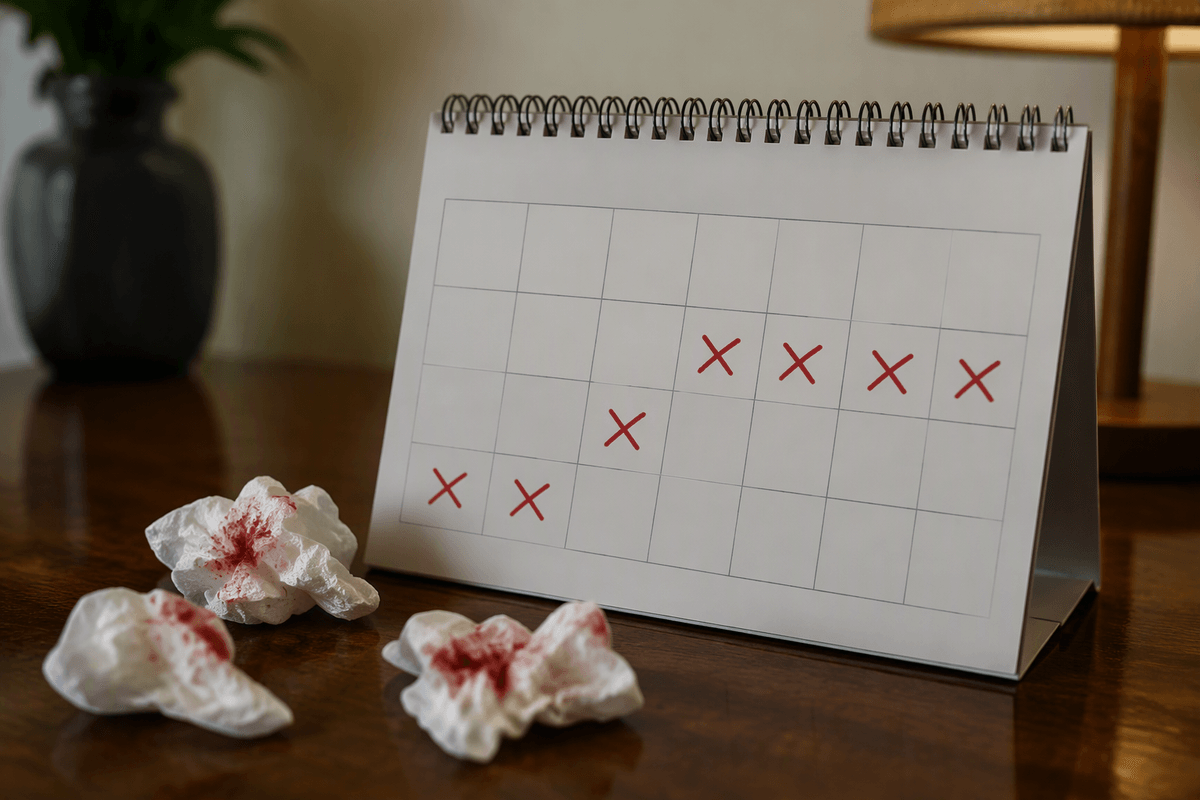
The small details start to add up when you’re not doing much at all—no hard blowing, no dry-air “sting,” no obvious scab you can feel—yet the bleeding still shows up. A common misunderstanding is to blame each episode on the last one (“I must have reopened it”), but an overall bleeding tendency can look different: the nosebleed starts easily, the flow stays looser and more watery, and it takes longer to settle even with steady pressure. You may also notice it happening from either nostril at different times, or recurring in clusters across several days.
What makes practitioners pause is the wider pattern outside the nose. If you’re bruising with minimal bumps, seeing gum bleeding when you brush, or noticing blood where it shouldn’t be (urine, stool), that’s a different category than simple irritation. Medications that affect clotting, regular heavier alcohol intake, and even a recent illness can all shift the “stop-ability” of the same small crack—so the trigger looks minor, but the bleed behaves bigger.
When irritation becomes a cycle you can’t break
It often shows up as a sore, tight spot you can’t quite point to—then, the next morning, there’s a little crust that feels “ready” to come off. You blow your nose before a meeting, or rub the itch from allergies, and the same side starts again. In that loop, the bleed isn’t getting worse because the vessel is “deeper”; it’s because the lining never gets a clean stretch of time to seal. A tiny scab forms, then gets softened by steam, showers, or nasal spray, and finally torn by wiping, sniffing, or checking too soon.
One day it’s a few red streaks; the next it runs longer, especially if you’re taking a blood thinner, drinking more alcohol than usual, or sleeping in a very dry room. If the bleeding keeps restarting from minor contact over days to weeks, that pattern can matter as much as the amount.
Reasonable fixes that sometimes make bleeding worse

You lean closer to the mirror and the crust looks like the problem—so the “reasonable” move is to clear it. That’s where a lot of repeat bleeds get their momentum. Picking at a scab, swabbing hard, or rinsing until the tissue feels clean can strip off the thin seal that was finally forming. Even frequent checking—one quick wipe to see if it’s stopped—can be enough friction to start the same spot again, especially in a dry office or after a night of mouth-breathing.
Other fixes backfire in quieter ways. A decongestant spray may make the nose feel open, yet leave the lining drier and more fragile later. Strong menthol rubs or “medicated” balms can sting, then tempt more rubbing. And if you’re on a blood thinner or had more alcohol than usual, the same small irritation can look like a bigger failure—bleeding longer, clotting slower, and restarting with minor triggers—without the source actually changing.
Choosing between watchful waiting and same-day care
The moment it finally slows, the question becomes annoying: do you get back to your day, or does this one “count” as urgent? A lot of people decide based on the mess—how much blood they see—when the more useful clue is behavior. If steady pressure settles it and it stays settled once you start moving around again, watchful waiting often feels reasonable. If it keeps breaking through, or restarts the same day after you thought it was done, it can be harder to trust that it will stay quiet on its own.
Same-day care makes more sense when the bleed won’t reliably slow after about 20 minutes of firm pressure, when most of the blood is going down the throat, or when you feel lightheaded, unusually weak, or “off” in a way that doesn’t match the situation. It’s also a different decision if you’re on a blood thinner, the flow is heavy enough to soak through materials quickly, or you’re also noticing easy bruising or bleeding in other places. Sometimes it’s not panic—it’s just choosing a safer stop point.